
Pomona Water Reclamation Plant: 30% blower energy reduction with DO/Nmaster and SRTmaster
| Plant | Pomona Water Reclamation Plant, Los Angeles County Sanitation Districts, California |
|---|---|
| Size | 15 MGD |
| Project | "Transforming Aeration Energy in Water Resource Recovery Facilities through Suboxic Nitrogen Removal", funded by a competitive U.S. Department of Energy grant (DE-EE0009509) awarded to Carollo Engineers |
| Control systems | DO/Nmaster (airflow, dissolved oxygen and ammonia) and SRTmaster (sludge age) |
| Result | Aeration energy fell from 1,300 to 550 kWh per million gallons of influent. New blowers reduced blower energy by 34%; lowering dissolved oxygen with DO/Nmaster and SRTmaster then reduced it by a further 30%. |
| Source | U.S. Department of Energy final report (Young et al., 2025); Dr. Alex Ekster is a co-author |
| Recognition | 2025 CASA Excellence in Innovation and Resiliency Award, awarded to the Los Angeles County Sanitation Districts and Carollo Engineers |
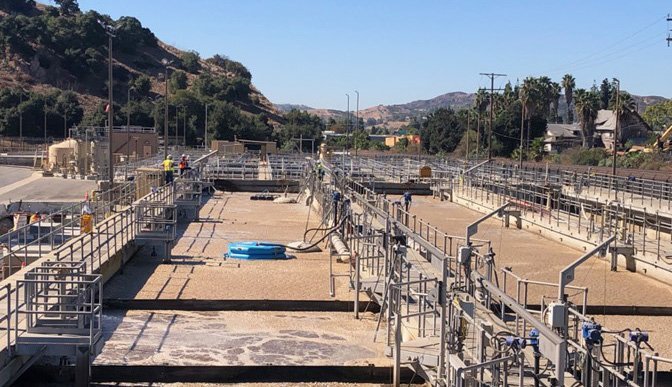
The plant and the project
The Pomona Water Reclamation Plant is one of the treatment plants of the Los Angeles County Sanitation Districts, which serve 5.5 million people. It has a capacity of 15 million gallons a day and removes nitrogen biologically.
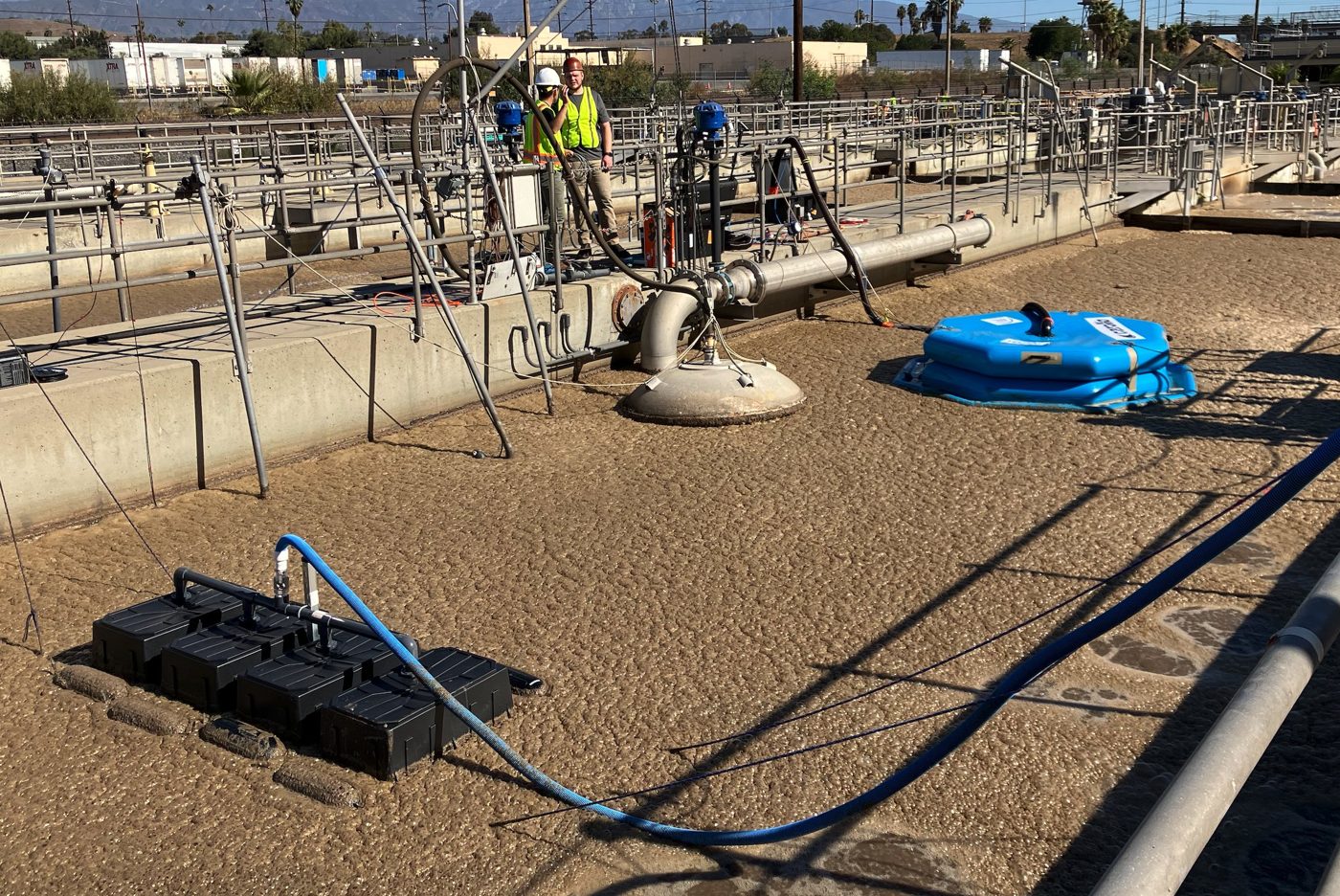
The plant was the site of a full-scale demonstration funded by a competitive U.S. Department of Energy grant (DE-EE0009509) awarded to Carollo Engineers. The aim was to operate the aeration tanks at low dissolved oxygen, which reduces the air the process needs, while maintaining nitrogen removal. Ekster & Associates supplied the DO/Nmaster and SRTmaster control systems; Dr. Alex Ekster is a co-author of the final report.
The work built on The Water Research Foundation Project 5148, in which the same team (the Sanitation Districts, Carollo Engineers and Ekster & Associates) implemented machine-learning ammonia-based aeration control at Pomona.
What was done, in order
- New blowers. The plant's 50-year-old centrifugal blowers were replaced with high-efficiency turbo blowers, completed in March 2023.
- New control. DO/Nmaster and SRTmaster replaced the conventional PID control of aeration and sludge wasting.
- DO/Nmaster calculates the airflow, dissolved oxygen and valve-position setpoints for each aeration grid.
- SRTmaster calculates the waste sludge flow that holds the sludge age on target.
- Both send their setpoints to the plant's SCADA system using the standard OPC protocol. The plant's own controllers continue to operate the blowers and valves.
- Lower dissolved oxygen. From January 2024, the dissolved oxygen targets were lowered gradually from 2.5 mg/L.
Results (U.S. Department of Energy final report)
| Measure | Result |
|---|---|
| Aeration energy, whole project | 1,300 kWh per million gallons of influent before; 550 after |
| Saving from the new blowers | 34% less blower energy |
| Further saving from lowering dissolved oxygen with DO/Nmaster and SRTmaster | 30% less blower energy |
| Share of the whole-project saving attributed to the control systems | More than 40% (308 kWh per million gallons) |
| Blower energy, DOE techno-economic measure | 999 kWh per million gallons (June 2019 – June 2020) to 520 (September 2024), against a DOE target of 650 |
| Total inorganic nitrogen removal | About 84%, before and after the change to low dissolved oxygen |
| Ammonia control | Precise enough to reduce or eliminate the aqueous ammonia added for chloramination |
The two baselines in the table cover different periods and measures in the report: 1,300 kWh per million gallons is the project baseline for aeration energy, and 999 kWh per million gallons is the baseline of the techno-economic analysis (June 2019 – June 2020).
The blower step and the control step are separate. The new blowers produced the first 34%. The further 30% came after the blowers had been replaced, from lowering dissolved oxygen with DO/Nmaster and SRTmaster.
How precisely the systems controlled the process
| Controlled variable | Result |
|---|---|
| Airflow, DO/Nmaster | 0.75% average error and 0.25% median error, in a 24-hour test with the setpoint changed every 3 seconds |
| Dissolved oxygen, DO/Nmaster | 0.06 mg/L average error, against 0.20 mg/L with tuned PID control, with setpoints from 0.5 to 2 mg/L |
| Sludge age, SRTmaster | 0.13 days average absolute error, less than 2% |
Precise control is what makes low dissolved oxygen operation safe. When dissolved oxygen is held close to its target, the target can be set lower without risking ammonia limits.
The airflow meters had a time constant of 0.18 seconds, and the valve actuators had a position accuracy of 0.1%. Ekster & Associates sells no instruments, and provides recommended performance specifications.
Operators kept authority
Operators set the targets and limits within which DO/Nmaster and SRTmaster operate, and can override them at any time. Every reading is checked before it is used. Faulty readings are detected and not acted on, and operators are alerted. If a control system or its communication link stops, the plant's own control system responds according to the fallback logic programmed for the plant.
Recognition
The Low Dissolved Oxygen Project at Pomona received the 2025 CASA (California Association of Sanitation Agencies) Excellence in Innovation and Resiliency Award, awarded to the Los Angeles County Sanitation Districts and Carollo Engineers.
Current work at Pomona
- BLANKETmaster: the Sanitation Districts awarded Ekster & Associates a contract for BLANKETmaster on the secondary clarifiers in October 2026.
- CLmaster: full-scale work on The Water Research Foundation Project 5385, "Machine Learning Meets Disinfection", led by Carollo Engineers with Ekster & Associates as co-principal investigator, began in October 2026.
Results will be published when they have been measured.
References
- Young, M. et al. (2025). Transforming Aeration Energy in Water Resource Recovery Facilities (WRRFs) through Suboxic Nitrogen Removal (Final Report). U.S. Department of Energy, DE-EE0009509, published 4 September 2025. DOI 10.2172/2587564.
- CASA News, 21 August 2025: 2025 Excellence in Innovation and Resiliency Award.
- The Water Research Foundation Project 5148.
Pomona plant staff are available to speak with other utilities.
Next step: a free plant assessment
Send one year of operating data and energy bills to info@srtcontrol.com. You will receive a written estimate of savings in kWh and dollars, the assumptions behind it, any changes required before installation, and a fixed price. If your plant is already operating efficiently, the estimate will say so.